Showing posts with label Art. Show all posts

Wednesday, 22 September 2010

Culture Watch - Tamara Karsavina

A painting of Tamara Karsavina revealed at London’s Wellcome Library after years of being wrongly identified:

See here for the painting.

(And you can see the likeness of the painting to the person here.)

Tamara decided to learn English after achieving the position of Prima Ballerina Assoluta in Corsair in 1909, and so perhaps the pages in her hand are by Swinburne or Robert Lewis Stevenson – two authors she read to help her learn. Or maybe she is reading a letter from home.

Tamara Karsavina lived in Frognal, Hampstead in the early 1960s. Many Hampstead houses declare the names of people who lived between their walls, but there isn’t a plaque on Tamara’s house.

Saturday, 9 January 2010

The Romantic Manifesto

I have been asked to recommend a work by Ayn Rand, so I recommend The Romantic Manifesto, which would stimulate anyone with an interest in the arts.

It has a purist thrust and an intellectual vigour and integrity that is admirable. I do not agree with everything she argues, for instance, her disapproval of the historical novel, which she dismisses as a work by a writer who does not possess volition; a writer incapable of abstract projections and confined to "representations of concretes" because of his (she uses the male pronoun throughout) crippled intellect. This is not a universal truth that should be applied to a historical novelist, or playwright for that matter. Any historical figure acting as a muse becomes an abstract projection; it does not necessarily follow that a historical novel denotes a biographical or journalistic style that will diminish both its subject and the reader, offering only second rate metaphysics.

The Romantic Manifesto doesn’t discuss the make-up of the imagination at length, but Ayn does talk about a subconscious process of emotional abstraction that gives man his individual sense of life. If his value judgements develop in the integral, rational manner Ayn believes they should, then this sense of life reaches maturity in the form of a conscious philosophy where the mind leads and emotions follow. This should have happened by the end of adolescence. Sadly, Ayn believes only a few of us achieve a conscious integration of reason and emotions, of mind and values. All sorts of neurotic afflictions cloud the minds of those who don't. Many of us are walking around tortured by contradictions or guilt or delusions. An example of a work of art created by a man whose mind has not reached a normal, fully focused, mental state with a clear-cut identity is the recreation of a fog of feelings in which A is not A but any non-A one chooses; where nothing can be known with certainty and nothing is demanded of one’s consciousness.

I have challenged the idea that a rose is a rose is a rose, or A is A is A, in this blog before by pointing readers in the direction of Rachel Campbell-Johnston's review of this year's Turner prize winner (Ayn would have loathed Richard Wright’s work anyway because she despised all genres of modern art). Yet you can even find the building blocks of the “A is B” argument played out in The Romantic Manifesto. In an anecdote, Ayn writes that when she was 16 she attended an art class where she fell in love with the artistic style of her teacher who taught that every curve must be drawn, not as a curve, but as broken facets of intersecting straight lines. So, a curve is not a curve, but a tapestry of intersecting straight lines; A is B.

Read this book for its attack on mysticism, its insightful definitions of art forms, the images used to describe literary experiences, its love of America, but most of all for Ayn's definition of love.

Tuesday, 8 December 2009

Turner Prize Review

A rose is a rose is a rose.

No no no.

Rachel Campbell-Johnston's Turner prize critique in today's Times is a joy to read: http://tinyurl.com/y8l8zll

Friday, 4 September 2009

Damien Hirst and Cartrain

I have a piece of advice for the 17-year-old graffiti artist, Cartrain, who crossed boundaries to take on Damien Hirst.

(Here is the story in today's Independent: http://tinyurl.com/nodv8o)

In a game of David and Goliath, Goliath always wins.

Tuesday, 1 September 2009

Graffiti Art

Art critic Brian Sewell has made my blood boil, which he might think is a compliment, but it really isn’t meant to be.

Here he is in The Guardian today proclaiming his superiority over everyone else’s idiocy: “The two words ‘graffiti’ and ‘art’ should never be put together,” he scoffs. “The public doesn’t know good from bad. For this city (Bristol) to be guided by the opinion of people who don’t know anything about art is lunacy. It doesn’t matter if they (the public) like it. It will result in the proliferation of entirely random decoration, for want of a better word... Any fool who can put paint on sculpture or turn a cardboard box into a sculpture is lauded. Banksy should have been put down at birth. It’s no good as art, drawing or painting. His work has no virtue. It’s merely the sheer scale of his impudence that has given him so much publicity.”

First of all, not all modern art is lauded. Secondly, spray can art is entirely different to conceptual “art”. Real graffiti art, as opposed to gangs who go round plastering their tags all over estates, is highly skilled. It involves vision, perspective, proportion and a good hand. There is bad graffiti art and good graffiti art. Sewell doesn’t like it because of its cultural associations.

http://tinyurl.com/lctsp8

Banksy is good art that Sewell doesn’t like. End of story.

Tuesday, 28 July 2009

Fourth Plinth - One and Other

The deep theological question about whether Holy Communion is art was posed in Trafalgar Square this morning when a Methodist minister from Somerset stood on the Fourth Plinth and led a worship celebration of Communion. Ken Chalmers from Castle Cary was one of 2,400 people appearing on the Fourth Plinth between 6 July and 14 October 2009, picked from more than 28,000 applicants for sculptor Antony Gormley’s One and Other project.

It is an art project and the participants are known as the plinthers. So, is Holy Communion art and did Ken’s appearance on the Plinth answer the question? Ken told me he hadn’t:

“No, and I don’t think that can ever be answered,” he said. “I don’t think we ever wanted to show Holy Communion as art. Antony Gormley said that one of his aims was to explore the connection between people and, for me, worship is a connection. So, that is what we were using – the opportunity to connect with each other, with the wider community through our prayers and with God. Is Communion art? No. Is it right to do it in this way? I don’t know, but I feel deeply that it should be.”

Here is Ken on the plinth:


The great thing about the Methodist tradition is that you don’t have to be christened, baptised or confirmed to receive Communion, as you do in some other Christian denominations. This means people like me can receive it with no questions asked and no more commitment made other than commitment to the moment of sharing Communion. You don’t have to give your name or be declared “special”; everyone is equal in receiving Communion.

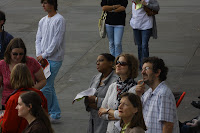
Here is glimpse of the crowd of onlookers:


Here they are again, lost in reflection:

And another kind of contemplation (spotted by photographer Anna Drew taking pics on behalf of Copyright Trustees for Methodist Church Purposes!):


Check out One and Other website here: http://www.oneandother.co.uk/

Thursday, 4 June 2009

The Berlin Wall

A couple of weeks ago I uttered the phrase, “it would be like talking to a brick wall”. I meant it to mean exactly what the expression is commonly understood to mean – a communication that has broken down because one person or party has ceased to communicate while another person or party still has a message to convey. But not all walls are silent (stay with me here!)

The longest remaining stretch of the Berlin Wall – the East Side Gallery stretching 1.3 kilometres – is being given a fresh lick of paint. As part of a 2.5 million euro project funded by the Berlin Senate, the federal government and lottery money, the 118 artists who created murals along the wall following its collapse in November 1989 have been invited back. The old murals covered with graffiti (like the one taken on my mobile phone) are being stripped and then repainted.

The wall has a double-edged magnetism because some of the visitors who stop to admire the murals feel compelled to write on them too. No one stops them. I just hope, when the revamp in preparation for the 20th anniversary of the fall of the Berlin Wall is finished, that the authorities won’t think it necessary to put a barrier all along the wall to stop people getting close to it. That would be too terrible an irony.

Tuesday, 21 April 2009

Artistic Licence

On the theme of letters to the editor, here is one I wrote to The Telegraph a couple of years back when I was a student (it is the ninth letter on the page when you scroll down and is headed 'Artistic Licence'):

http://www.telegraph.co.uk/comment/letters/3614241/The-Daily-Telegraph-letters.html

I wrote it at the desk of my overpriced digs in Jericho. It was past 10pm. My boyfriend at the time was driving all the way from Somerset to Oxford on the spur of the moment. I decided to write this letter to kill time waiting for him. By the time he arrived, I was engrossed. I remember greatly appreciating his patience after he had waited for me to finish it.

I was surprised but pleased it was published a few days later when I had almost forgotten about it!

Wednesday, 18 March 2009

Dans Le Monde Du Pape

Anyone who has ever fallen in love with an illusion will have great sympathy with the anonymous young writer in the film, Dans La Ville de Sylvia, as he walks around Strasbourg consumed by the projection of his muse. Because he (the actor Xavier Lafitte) is beautiful, and his fantasy harmful towards no one but himself, the sensitive artist is easily forgiven.

The Pope, however, is not.

Today’s papers are full of reports about how Pope Benedict XVI has announced that condoms are not the answer to Africa’s fight against HIV and Aids.

Speaking to journalists on his flight to Cameroon, the Pontiff said the condition was, "a tragedy that cannot be overcome by money alone; that cannot be overcome through the distribution of condoms, which even aggravates the problems".

I wish it were an illusion that this man’s belief in a misogynistic, homophobic and sadistic God could not affect the lives of so many Christians across the world. According to a report in today’s Guardian, 22 million people in sub-Saharan Africa are estimated to be infected by the disease. Past BBC reports say that there are 143 million Catholics in Africa.

If I didn’t know there were outreach programmes in Africa spreading the right message about HIV and Aids prevention, including Christian outreach programmes, my despair would be a lot greater.

The final scene in Dans La Ville de Sylvia shows how successful the director, Jose Luis Guerin, has been in transferring the artist's projection on to the viewer. The camera holds still showing a shot of a street in Strasbourg. People walk in and out of the frame and, while Xavier remains out of it, there is a palpable lightness of being. I sat there bracing myself for Xavier’s entrance and for, what by this point has become, the heaviness of his desire.

But he doesn’t come.

Monday, 17 November 2008

The Price of Art

The Independent newspaper reported today that artist Damien Hirst has come out and said that the art market is overpriced. The Stuckists will rejoice! I, for one, am glad that Hirst, who is worth £200 million, has come out and talked about the price of art - when Piers Morgan interviewed Tracey Emin last month, she skirted around discussing the price of her art.

Hirst's line is: "Art is worth what the next guy is prepared to pay." I think that misses the point. Art pricing is based on what YOU are prepared to pay.

A friend of mine recently struck a deal with an artist who said he would sell his two canvases for £120. But my friend said that was underpriced and he wanted to pay more. So he paid him £150.

It would be revolutionary if Hirst made the price of art the subject of his next work. But that isn't likely to happen any time soon. "You feel as if you are touched by God," he is quoted as saying in reference to his success on the art market. And elsewhere in the same article: "That is what artists want, for people to hang the works on the wall."

But the best line is this: "As an artist, you don't stop making art because people are not buying it." It would be great if Hirst plonked his next idea in the middle of Leicester Square, next to all the portrait artists who sit in the wind and the rain everyday, and said: "No one is buying this -this isn't for sale."

I wonder what would happen and how long Hirst would be able to hold out?