Showing posts with label Methodism. Show all posts

Monday, 20 February 2012

Nick Cohen's Attack on Jonathan Gledhill and Alan Beith

Another article by Nick Cohen inspiring a blogpost - this time in the Spectator. Here’s how it starts:

If you want to hear a BBC discussion going hopelessly wrong, listen to the ‘debate’ between the Bishop of Lichfield, Jonathan Gledhill (brother of the better-known Ruth) and Alan Beith on the Today programme this morning. Radio 4 meant it to be about the established church, and set the Anglican bishop against the Methodist Beith.

Did they? Methodists and Anglicans have been in Covenant since 2003. They are not arch-enemies out to slay one another. They work together ecumenically, share local churches together and support each other on a number of social issues. Also, Ruth Gledhill is not related to Jonathan Gledhill - an error that Ruth has pointed out on Twitter.

But a freemasonry of the faithful took over, and ‘balance’ went out of the window. Conformist and non-conformist united against their common enemy, ‘militant secularism’. Not just Anglicans and Methodists, Beith assured us, but Sikhs, Jews, Muslims and Hindus were at one in their fear of the secularist menace.

“Freemasonry”? An unfortunate term in this context. The first definition of freemasonry in the Oxford English Dictionary reads: “The system and institutions of the Freemasons.” Back in 1985 the Methodist Conference voted that Freemasonry competed with Christian beliefs. Cohen, however, would have meant the second definition of this term: “Instinctive sympathy or fellow feeling between people.” A less ambiguous choice of words would have been “a shared perspective”. The jumbled phrases continue through the paragraph with Cohen suggesting that Sir Beith says that Anglicans, Methodists, Sikhs, Jews, Muslims and Hindus are in “fear of the secularist menace”. He didn't say anything like this. In fact, Sir Beith stands up for the views of atheists, some of whom would agree with Mary Ann Sieghart's piece in the Independent this week.

‘It is bad enough having to put up with the platitudinous propaganda of Thought for the Day,’ I thought, ‘but this is too much.’

Thought for the Day takes up roughly one minute of scheduling time. It’s topical, features participants of different faiths and, I think, would be an even better slot if it featured humanists too. Why didn’t Cohen lay into the Sunday Programme, which lasts 45 minutes every week? Maybe he likes the Sunday Programme.

Friday, 2 September 2011

Greenbelt 2011

I’ve experienced a kind of Greenbelt overload since last week. I think this is because it was the first time I'd been and also because of what I was doing there: reporting for the Methodist Recorder and compiling a podcast for Methodist Web Radio. The podcast is here and the Recorder piece will be out next week.

Here are a few photos from the festival:


The Mainstage at Greenbelt


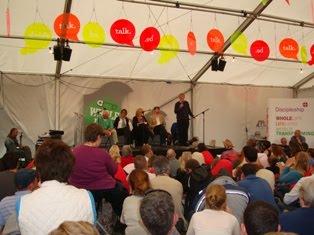
Debate on poverty in the UK


George Luke, DJ and gig organiser for the Performance Cafe


The Performance Cafe


Writer and performer, Stella Duffy


Me in front of Mainstage in between rain showers, looking no way near as stylish as Stella.


Wednesday, 30 September 2009

Hyderabad, India, September 2009

A snapshot of Hyderabad, India, September 2009:

A woman walks across the road in Hyderabad.

A young man selling vegetables.

The pavement is so busy, it is actually easier to walk on the road!


Shoppers in Hyderabad.


Taking it easy!


Shop window.
Roof top view of the city.
An English Methodist Church in Hyderabad.
Manequins in a shop window modelling long kurtas.


A very blurry picture of women celebrating the festival of Durga, the Hindu Goddess of power. You can't really see in this picture, but they were letting floating candles drift out on to the lake.


Hyderabad.


Outside the Vivekananda Institute of Human Excellence. I can tell you what I was briefly told about Swami Vivekananda. Swami Vivekananda was a liberal Hindu who revived Hinduism at the end of the 19th century in a way that appealed to the secular mind and to Hindus who felt oppressed by the caste system. He was also a strong advocate of interfaith relations, believing that one faith alone could not lead to the truth. However, his spirtual philosophy was intellectual and so it did not catch on in the mainstream. I bought a couple of his quote books for a few rupees at a store outside the Institute.

Religious leaders from different faiths talk about overcoming violence and making peace in the world at the Vivekananda Institute in Hyderabad.

The guy in the orange is Swami Srikanthananda. He expressed some wonderful ideas: "Religion is realisation, it is experience, it is not only theory." He also repeated a Vivekananda quote: "Religion is the manifestation of the Divinity already in man." And some other powerful stuff: "When we try to limit God, we become enemies."

Another one of Swami Srikanthananda's beliefs which resonated with me was this: "It is a sin to say we are all sinners. We are all divine souls." It made me think about Christianity, which has strong ideas about sin. I think one of the helpful things about Christians recognising "sin" (or "wrong doing", as I prefer to say) is that it allows injustice to be recognsied and acted upon. I believe passionately that social justice falls within the ambit of religion and many denominations of Christianity advocate this too (Methodism, for example). Something that can happen within Christianity is the glorification of suffering. I, along with others, had to bite my tongue as I listened to a sermon by a preacher doing just that to Christian Pano Dalits and Kandho tribals in Kandhamal, all of whom had lost their homes and many of whom had lost loved-ones following persecution by Hindu fundamentalists in August last year. Hearing that St Paul became a Saint after his head was chopped off just made me feel exasperated. However, many Christians will tell you that Christianity is not about the glorification of suffering.

I also listened to a stirring speech on peace by a Brahma Kumaris follower called Sister Kanti. She said: " All that I create carries some energy, so if I create a peaceful thought, then I create peaceful energy." The idea is that peace starts with a peaceful thought. So simple and so true. She recommended meditating on peace for 15 minutes every morning. The meditation would go like this: "I am a peaceful soul, happiness is within me, I do not search for anything outside myself."

Sister Kanti also said that long, long ago, there was a world that was 100 per cent peaceful and that we have "come down" from this time and now hope to return there. If this is "devolution", then I am prepared to consider it...

...I asked Swami Srikanthanandra when he believed the time would come to go back to this world of 100 per cent peace. He said that that place was within me, as it was within everyone.

Thursday, 17 September 2009

The Atheist's Guide to Christmas

My colleague, Anna Drew, received a gift copy of comedian and Guardian newspaper columnist Ariane Sherine’s book “The Atheist’s Guide to Christmas” today. This is because Anna and Ariane went for coffee months ago to chat about the Atheist Bus Campaign: http://tinyurl.com/alelhf (Scroll down to January 6, 2009, to listen to Anna and Ariane.)

(Ariane thanked Anna for being so lovely about the campaign in a message accompanying the book.) Judging from Ariane’s Twitter feed today, lots of others have received her book too (well, the book she has edited).

I have just read the “Welcome to this book” page which includes a classic joke about agnostics: “(In this book there are) an undecided number of jokes about agnostics (we wanted to write some, but we weren’t sure, and then we thought we might, but we weren’t certain.* For the purpose of this Christmas book, they should henceforth be known as ‘eggnostics’.)”

In The God Delusion, Professor Richard Dawkins actually reserves his greatest contempt for agnostics.

Nevermind the atheists - if there is any group that is not piping up and organising itself, it is the agnostics. Someone really should put the backbone back into agnosticism. I am just too busy at the moment.

Tuesday, 8 September 2009

Corporate Commitments to Carbon Cuts

Yesterday I was William Donaldson (http://tinyurl.com/n5bpy6) and I managed to get The Guardian to publish one of my Henry Root letters, which appears in the paper today :)

Seriously though, here is a letter in The Guardian today by Revd Dr Martyn Atkins:

http://tinyurl.com/kpnzop (It is the third letter you come across scrolling down the page.)

While I remember The Henry Root Letters, one of the features I recall about Diplo Magazine (which went bust because the bright young things never did anything about advertising) was its commitment to republishing them.

http://tinyurl.com/dke8kg

Tuesday, 28 July 2009

Fourth Plinth - One and Other

The deep theological question about whether Holy Communion is art was posed in Trafalgar Square this morning when a Methodist minister from Somerset stood on the Fourth Plinth and led a worship celebration of Communion. Ken Chalmers from Castle Cary was one of 2,400 people appearing on the Fourth Plinth between 6 July and 14 October 2009, picked from more than 28,000 applicants for sculptor Antony Gormley’s One and Other project.

It is an art project and the participants are known as the plinthers. So, is Holy Communion art and did Ken’s appearance on the Plinth answer the question? Ken told me he hadn’t:

“No, and I don’t think that can ever be answered,” he said. “I don’t think we ever wanted to show Holy Communion as art. Antony Gormley said that one of his aims was to explore the connection between people and, for me, worship is a connection. So, that is what we were using – the opportunity to connect with each other, with the wider community through our prayers and with God. Is Communion art? No. Is it right to do it in this way? I don’t know, but I feel deeply that it should be.”

Here is Ken on the plinth:


The great thing about the Methodist tradition is that you don’t have to be christened, baptised or confirmed to receive Communion, as you do in some other Christian denominations. This means people like me can receive it with no questions asked and no more commitment made other than commitment to the moment of sharing Communion. You don’t have to give your name or be declared “special”; everyone is equal in receiving Communion.

Here is glimpse of the crowd of onlookers:


Here they are again, lost in reflection:

And another kind of contemplation (spotted by photographer Anna Drew taking pics on behalf of Copyright Trustees for Methodist Church Purposes!):


Check out One and Other website here: http://www.oneandother.co.uk/

Saturday, 4 July 2009

Sexually Progressive Words from a Methodist

Great speeches from the new President and Vice-President of the Methodist Conference at Wolverhampton's Civic Hall today.

Here is a taste from Dr Richard Vautrey, newly elected Vice President:

"Let’s just for a moment focus on sex, drugs, and rock and roll. Sex sells; it also has a habit of waking up a hot congregation. Any mention of sex triggers a Pavlovian response in the media and the related story is sure to get coverage. Mix sex and the church and you’ll hit the headlines.

"Now I don’t know what the after service conversation is like in your church, but talk about sex over the coffee and biscuits after the service is not commonly heard in the churches I’ve attended. Maybe I am going to the wrong churches. And yet according to the media, all churches are obsessed and divided by it. Now clearly we must challenge those that use sex in an exploitative way, in a degrading or dehumanising way. The excellent work done by Network highlighting the appalling situation of sex trafficking is exactly what we should be doing.

"However the Church is stereotyped as being riddled with homophobia. We’re also seen as hostile to sex, yet this is something that is one of the most natural and beautiful of God’s gifts. An image is created of the Church being almost less Christian and charitable than our largely secular society. Where society has made great strides to challenge discrimination and encourage equality and diversity, the Church is stereotyped as being bigoted, backward and blatantly obstructive to change. Yes these issues are important, yes they need to be sensitively and carefully handled, and yes, were the stereotype has evidence of some foundation it should be challenged, but my experience is that when Christians meet and get to know their neighbour, they reach out in love towards them. Their sexuality counts for little. Love breaks down the barriers that may have been there in theory but in the reality of a real relationship they melt away.

"So much for sex, let’s turn to drugs..."(it continues here: http://tinyurl.com/mvu8fk)

Friday, 3 July 2009

New Delhi Court Decriminalizes Gay Sex

A New Delhi court has ruled that consensual gay sex is not a crime, The Times reports today. The Delhi High Court ruled that applying the 1860 colonial law, which ranked homosexual intercourse alongside bestiality and paedophilia as “sex against nature” and punishable by 10 years in prison, violated the constitution and international human rights conventions.

One small step for the 21st century and a giant leap for humanity: http://tinyurl.com/mkbshc

There was a stirring article by Johan Hari in The Independent yesterday on the history of gay rights in this country ahead of London’s Gay Pride tomorrow: http://tinyurl.com/mtzuzp

If only the Church would wake up to the 21st century and sanctify civil partnerships. There is a lot of progressive talk at grass roots levels (in the more sophisticated circles of the Christian world, ie: http://tinyurl.com/mhk8o3), but at the decision-making levels there is still much coughing and buck passing. I am not up to speed with what is happening among other faith groups, but I imagine it is very similar. Meanwhile, humanism continues to live up to its name. Long may humanists continue to spread enlightenment.

Thursday, 2 April 2009

Archbishop of Canterbury Interview (well, almost)

This afternoon I very nearly interviewed the Archbishop of Canterbury, Dr Rowan Williams, who was at Methodist Church House in London for an annual Anglican-Methodist meeting.

Unfortunately, his meeting with the four strategic leaders of The Methodist Church overran (by eight minutes) and he had to be back at Lambeth Palace at 6pm.

The interview would have focused on the Anglican-Methodist Covenant signed six years ago, discussing examples of and barriers against unity between the two churches, before broadening out and exploring key issues which the Church should be addressing today. It would have been a three way interview with the President of The Methodist Conference, Rev Stephen Poxon, and would have been available to download as a podcast.

Oh well. There is always another time! (I hope.)